In a previous post we looked at how echolocation works and the three fundamental call types: FM sweeps, CF tones, and the composite “hockey stick.” Now let’s put that into practice. Jersey has recorded at least 18 bat species — a remarkable total for an island of just 120 km² — and their calls span an enormous range of frequencies, shapes, and rhythms. Here’s your guide to what you’re actually hearing on a bat walk.
Pipistrelles are the bats you’ll hear most often, and they’re a perfect demonstration of why acoustic identification is so powerful. Jersey has four species, and while they look almost identical to the naked eye, their voices are surprisingly different.
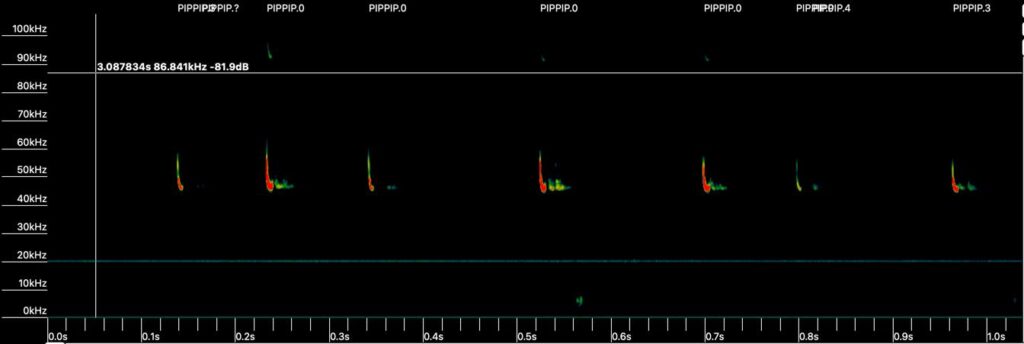
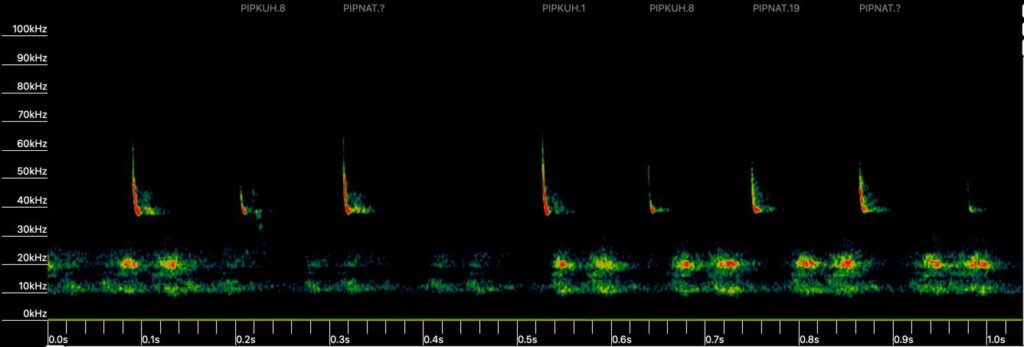
The common pipistrelle (Pipistrellus pipistrellus) produces composite FM/CF calls ending at approximately 45 kHz. The soprano pipistrelle (P. pygmaeus) is almost identical in shape but ends higher, at around 55 kHz. Kuhl’s pipistrelle (P. kuhlii) ends lower, at around 38–40 kHz, and Nathusius’ pipistrelle (P. nathusii) ends at around 36–40 kHz with a characteristically more regular, rhythmic call pattern.
On a heterodyne detector, the classic trick is to tune between 35 kHz and 55 kHz and listen for the strongest, clearest “smack” at each frequency. That tells you which pipistrelle you’ve got.
It was precisely this kind of acoustic detective work that revealed common and soprano pipistrelles as separate species in the first place. For decades, everyone assumed “the pipistrelle” was one species. Then bat workers noticed two consistent frequency peaks. In 1999, they were formally split — a taxonomic revolution that started with a bat detector.
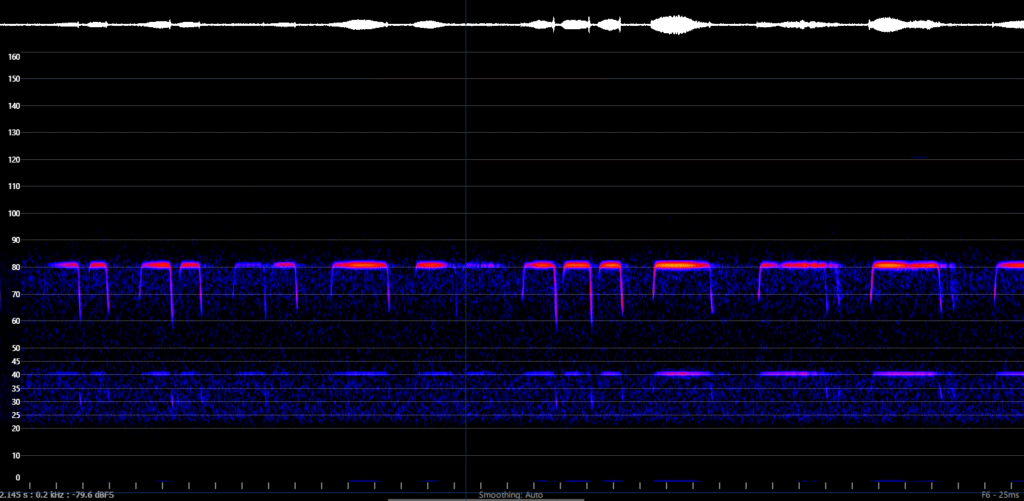
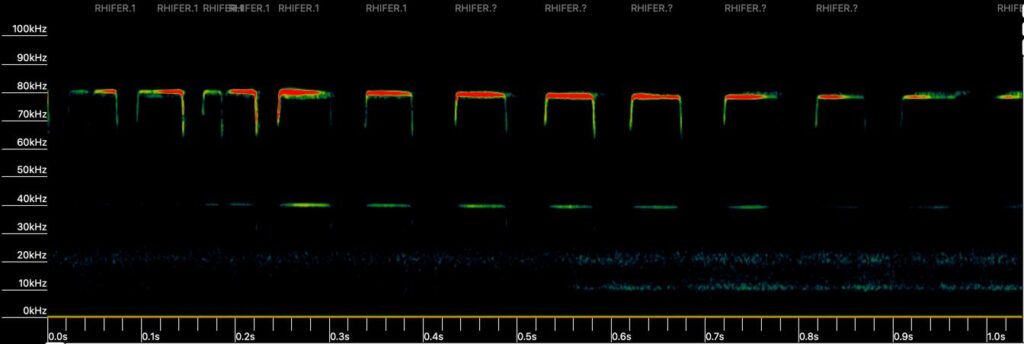
Both the greater horseshoe (Rhinolophus ferrumequinum, calling at around 80–83 kHz) and the lesser horseshoe (R. hipposideros, at around 110 kHz) produce long CF calls that show up as unmistakable horizontal lines on a spectrogram (with the shape of a horseshoe!). These bats emit their calls through their noses, using their elaborate horseshoe-shaped noseleaves to focus the sound into a narrow beam.
On a heterodyne detector, horseshoe calls sound like clear warbles or peeps, and the Doppler shift from their flight produces a distinctive pitch change that the heterodyne beautifully exaggerates. If you know the frequency, these are among the easiest species to identify — there is genuinely nothing else that sounds like a horseshoe bat.
Horseshoe bats also practise Doppler-shift compensation, lowering the frequency of their outgoing calls to keep echoes returning at their frequency of best hearing. This is what makes their CF echolocation arguably the most sophisticated biosonar system in the animal kingdom.
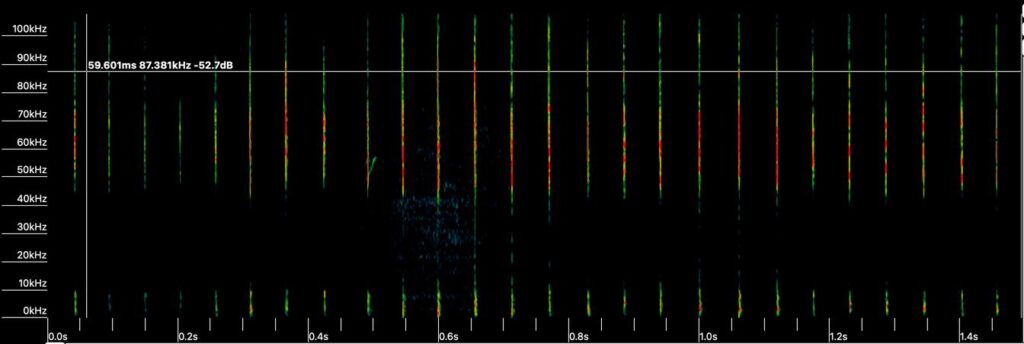
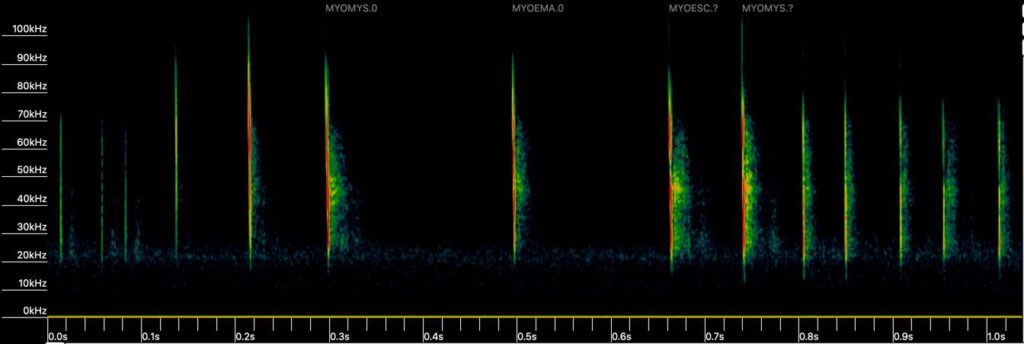
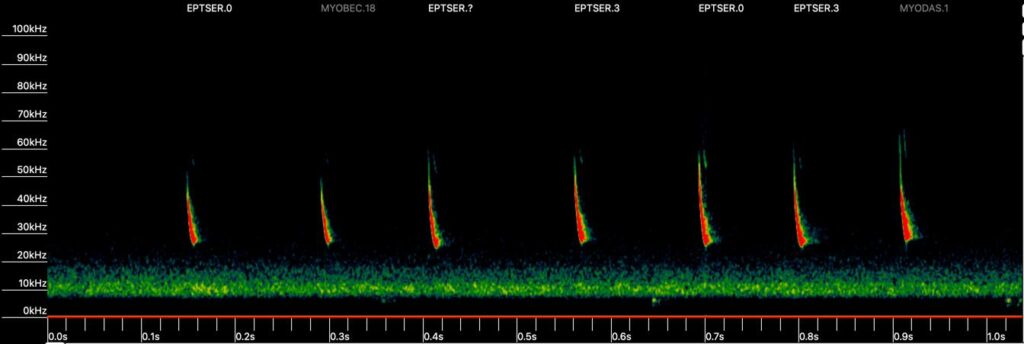
Now for the group that keeps acoustic analysts up at night. The Myotis genus — including Daubenton’s (Myotis daubentonii), whiskered (M. mystacinus), Brandt’s (M. brandtii), Natterer’s (M. nattereri), and others — all produce steep, broadband FM sweeps, typically between about 25 kHz and 80–100 kHz, that appear as near-vertical slashes on a spectrogram.
The problem is that these calls overlap heavily in frequency and shape. Daubenton’s bat produces regular, evenly spaced FM sweeps, often with a slight flattening towards the end when foraging low over water. But separating whiskered from Brandt’s, or Natterer’s from Bechstein’s, on acoustics alone is extremely challenging, even for experienced analysts using full-spectrum recordings. This is the group where trapping, DNA, or other methods become essential for confident species-level identification.
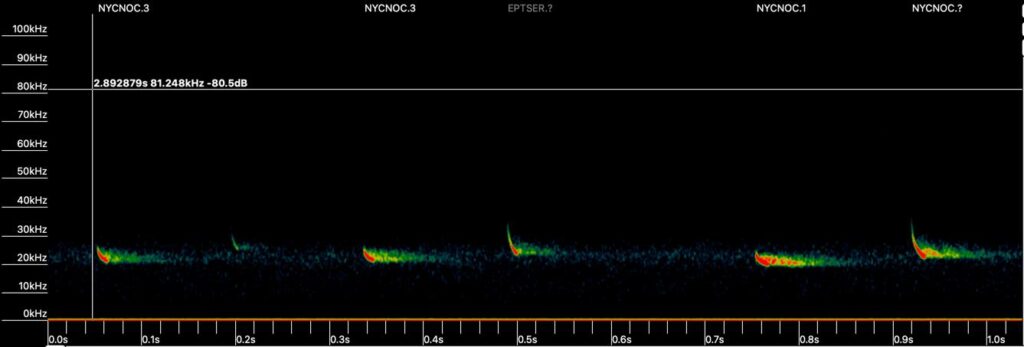
These are the heavy metal bands of the bat world. The common noctule (Nyctalus noctula) produces powerful calls at around 20–25 kHz that can carry enormous distances — you can sometimes pick up a noctule from 50–100 metres. Leisler’s bat (N. leisleri) is slightly higher at around 25–30 kHz. The serotine (Eptesicus serotinus) calls at around 27–35 kHz with a distinctively slow, erratic rhythm that bat workers often describe as “drunken” or syncopated.
On a spectrogram, noctule calls show a steep FM sweep followed by a shallow, almost flat tail — sometimes described as a “chip chop” alternation between a longer and shorter call. On a heterodyne detector at 20–25 kHz, noctules are loud, metallic, and unmistakable. Their calls are among the most intense airborne vocalisations produced by any animal — researchers have measured bat calls exceeding 130 decibels at 10 cm from the mouth.
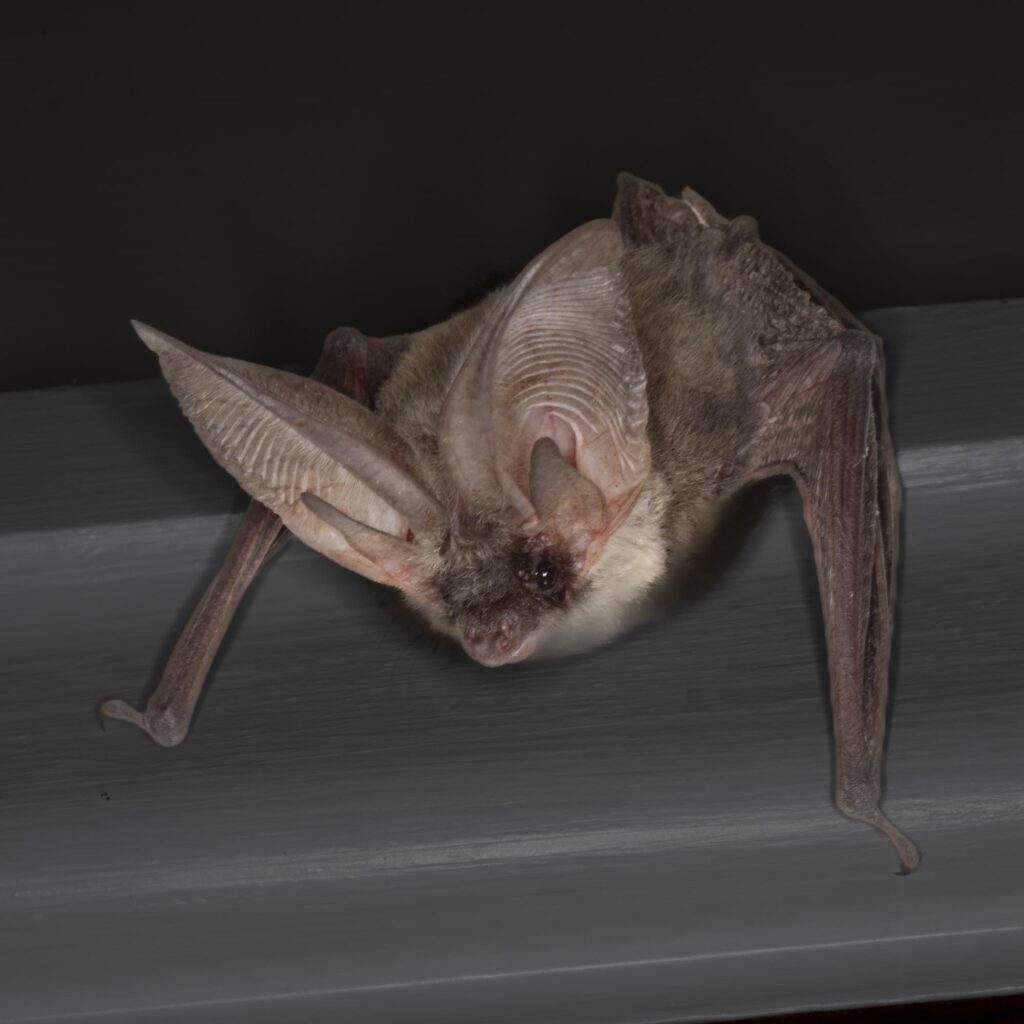
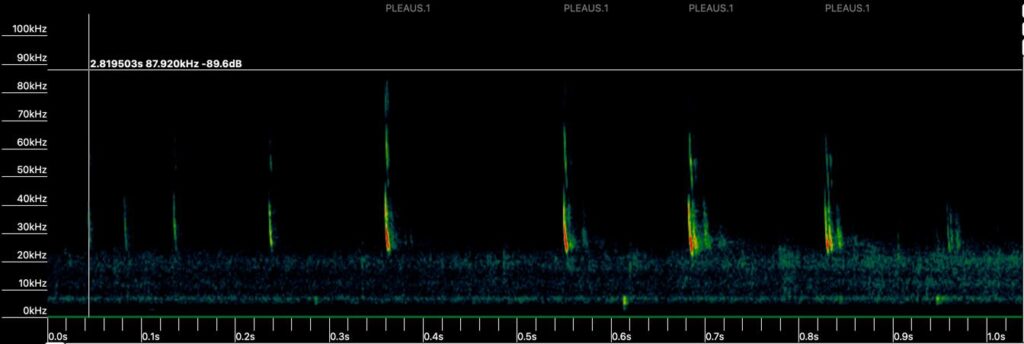
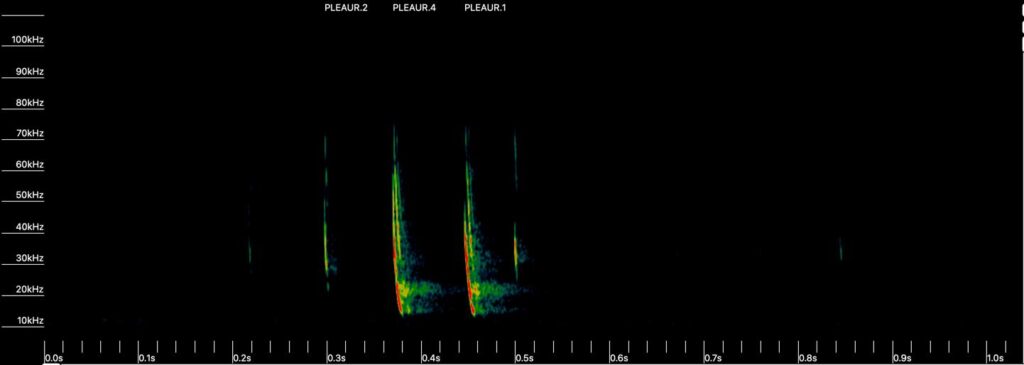
Jersey has both the brown long-eared (Plecotus auritus) and the grey long-eared (P. austriacus) — sometimes called “whispering bats.” Their echolocation calls are extremely quiet, typically broadband FM sweeps peaking around 45–50 kHz but emitted at very low intensity.
This is a stealth strategy. Many of the moths that long-eared bats eat can hear ultrasound, so by whispering, these bats avoid alerting their prey. They also rely heavily on passive listening — hearing the sounds of insects moving — rather than echolocation alone, which means they sometimes barely call at all. The downside for us is that you often need to be within a few metres of a long-eared bat to pick it up on a detector, and even then the signal may be faint.
Identifying species is only half the fun. Bats constantly adjust their calls depending on what they’re doing, and once you learn to read these changes, your detector becomes a window into bat behaviour in real time.
Search phase
When a bat is commuting along a familiar route, it produces slow, regular calls with wide spacing between pulses. On a detector: click … click … click … Steady, metronomic, unhurried.
Approach phase
When the bat detects something interesting, the calls become shorter, closer together, and often shift in frequency. On a detector, you hear the rhythm accelerate noticeably.
The terminal buzz
The most dramatic sound in bat detecting. In the final fraction of a second before catching an insect, the bat fires pulses at extraordinary rates — up to around 200 calls per second. The calls blur together into a continuous buzz. On a detector: “bzzzzt.” If you hear that, you’ve just eavesdropped on an insect capture in real time.
Habitat effects
Bats also modify their calls depending on their environment. In open air, calls tend to be longer, lower in frequency, and more narrowband — optimised for long-range detection. In cluttered environments like woodland, calls become shorter, higher, and more broadband — switching from detection mode to navigation mode. This is why the same species can sound subtly different in an open field versus a woodland ride.
Social calls
Not everything on your detector is echolocation. Bats are social animals, and they produce a whole repertoire of communication calls — for attracting mates, defending territories, and maintaining contact in flight. Social calls tend to be lower in frequency, longer, more variable, and sometimes surprisingly musical.
Male pipistrelles produce distinctive “songflight” displays during the autumn mating season, advertising from a territory with rhythmic sequences of alternating call types. On a detector in September or October, these sound quite unlike normal foraging echolocation — irregular, chirpy, almost songbird-like. Social calls are a growing area of bat research, and they’re revealing that bat communication is far more complex than we once appreciated.
Working to protect and conserve Jersey’s native bat species through research, education, and community involvement.
Join our mailing list to receive updates about bat walks, training, and events.
2025 Jersey Bat Group. All rights reserved.