

Jersey Grey Long-Eared Bat: New Guidance
If you’ve spent time watching bats over Jersey’s treelines and hedgerows on a warm summer evening, you may have glimpsed one without knowing it. The grey long-eared bat, Plecotus austriacus, is one of Jersey’s most remarkable resident species, and one of the least talked about. That may be about to change.
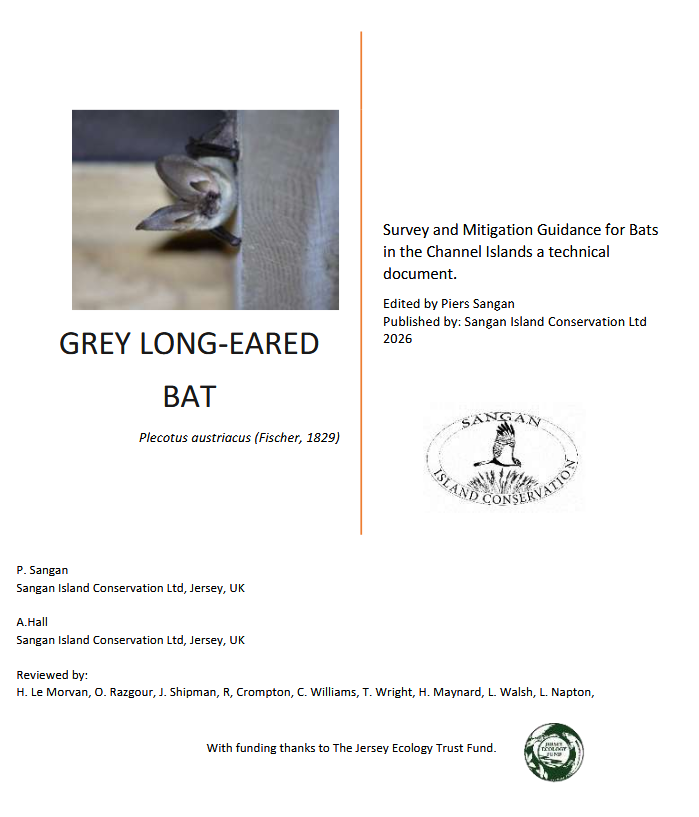

Recently, Piers Sangan and Dr Amy L. Hall from Sangan Island Conservation published new survey and mitigation guidance for grey long-eared bats in the Channel Islands – the most detailed account of the species in a local context ever produced, and an important milestone for bat conservation in Jersey. It’s a significant piece of work for the professionals and ecologists who will use it, and it’s prompted us to shine a spotlight on a bat that more than deserves wider attention.
Fieldwork contributors: Richard Crompton, Ellie Hack, Hannah Le Morvan
Guidance document reviewers: Hannah Le Morvan, Dr Orly Razgour, James Shipman, Richard Crompton, Dr Carol Williams, Dr Tim Wright, Holly Maynard, Lindsey Natpon
Those ears, though!
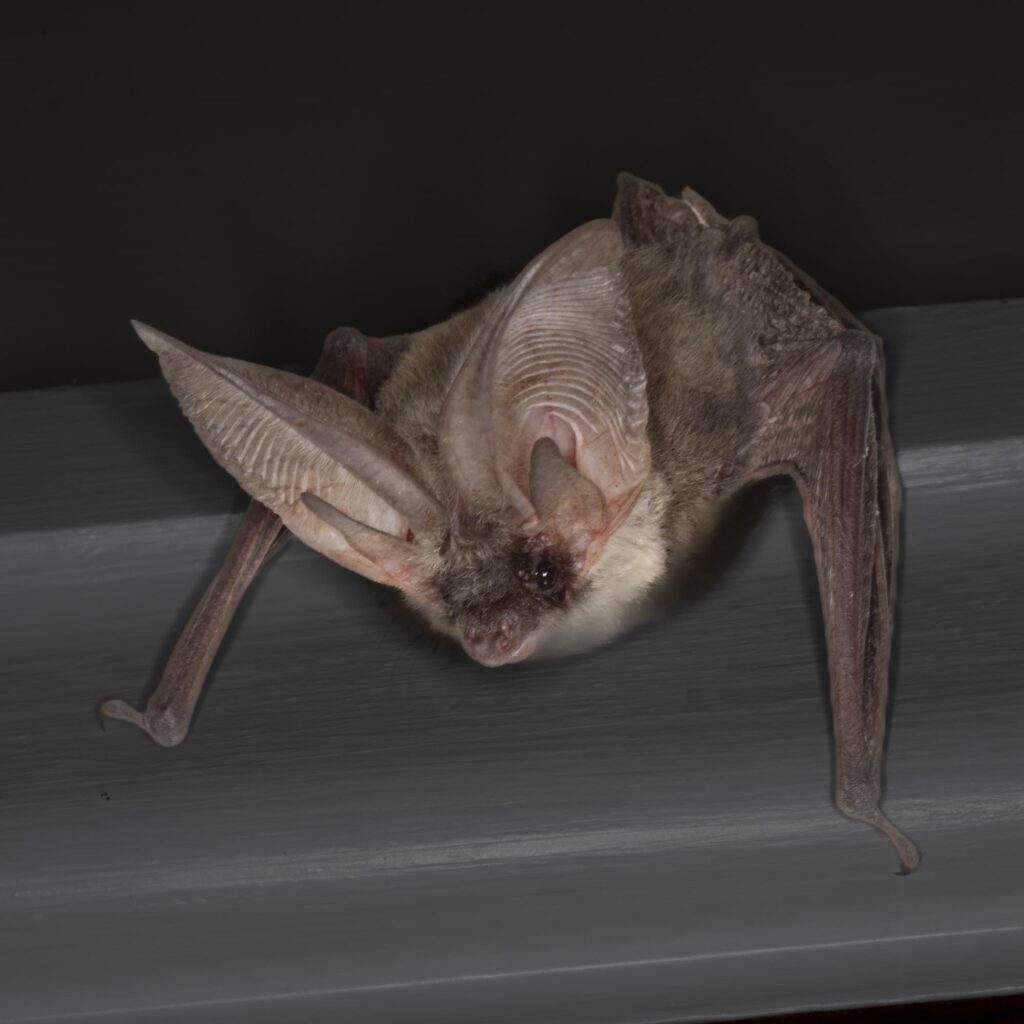
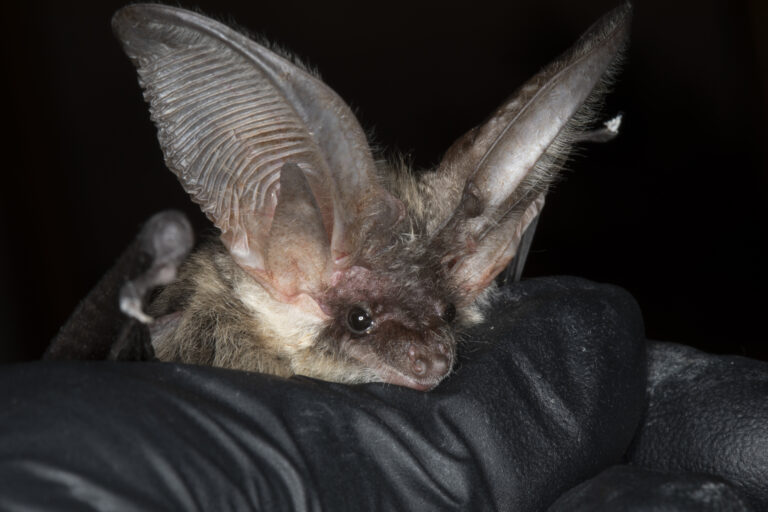
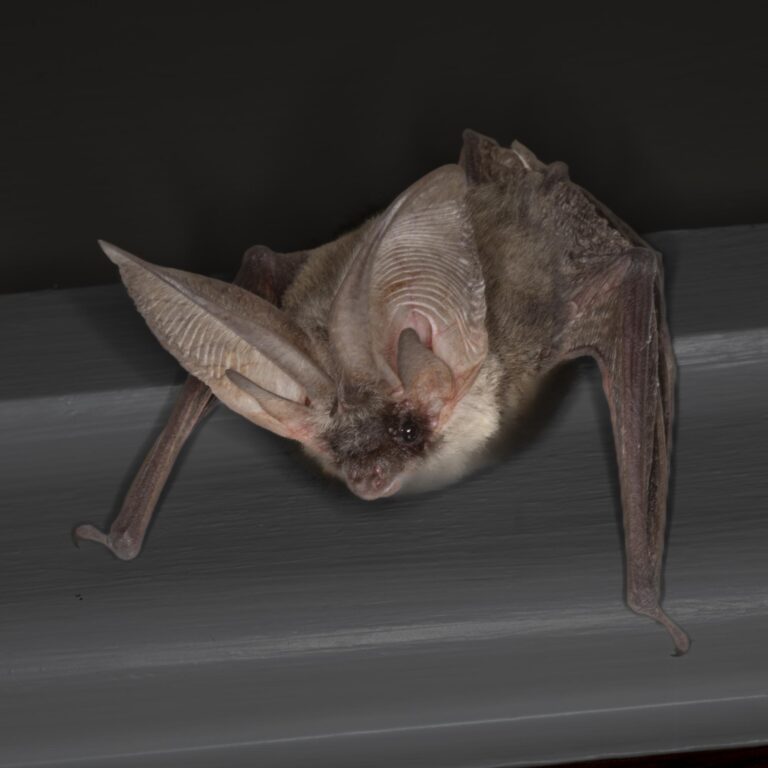
The grey long-eared bat is hard to mistake once you’ve seen one up close. It’s ears are extraordinary – around three quarters of the length of its body – and when at rest it tucks them neatly under its wing like a traveller folding an oversized map. Only the long, sword-shaped tragus (the inner ear projection) remains visible, pointing forward like a small antenna.
Its face is distinctive too! A long, slender, dark muzzle framed by characteristic black eye mask, and a sharp contrast between the grey dorsal fur and the paler underside. In the hand, it is genuinely one of the more striking bats you’ll encounter which makes it all the more satisfying when you find one.
Why Jersey matters for this species
Across most of its European range, the grey long-eared bat forms small maternity colonies, typically 10-30 individuals. Jersey, remarkably, holds one of the largest known roosts in the Channel Islands, with a peak post-breeding count of around 100 bats. For a species listed as Endangered in both Jersey and the UK, that is a genuinely significant population.
There are currently only four confirmed maternity roosts on the island, making each one critically important. These roosts are found in buildings with large, unlined roof voids, typically old granite structure with slate roofs and voids of over 3m. The kind of buildings that are increasingly rare, and increasingly at risk of renovation and development.
Jersey sits at the very western edge of the species’ European range. The fact that a viable, breeding population exists here at all is something worth celebrating and protecting!

A species with character
Beyond the biology, grey long-eared bats have a reputation among bat workers for being unusually inquisitive. At roost emergence surveys, it is not uncommon for bats to fly directly up to the surveyor, circling around legs, investigating equipment, apparently as curious about us as we are about them. For anyone who has experienced this during survey work, it is one of those encounters that is genuinely difficult to forget.
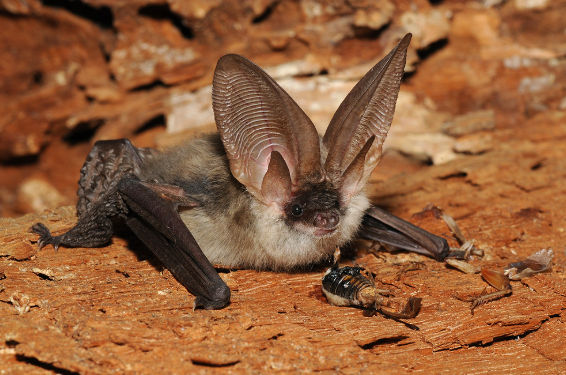
They are also accomplished hunters. Primarily moth specialists, they hunt by gleaning — picking prey directly off surfaces rather than catching it mid-air — with a particular fondness for the large yellow underwing moth. Bat workers surveying known roost sites often find the remnants of these meals nearby, a useful sign during professional survey work of where the bats have been active.
A quiet bat in a noisy world
One of the reasons the grey long-eared bat remains under recorded, even by the standards of a group that is generally hard to survey, is that it is remarkably quiet away from its roost. While most bats reveal themselves readily on a bat detector, this species can be almost impossible to detect acoustically when foraging away from known sites, which makes professional survey effort all the more important for building an accurate picture of population size and distribution.
This is one of the reasons the new guidance document represents such a step forward. It draws together the best available Channel Islands-specific knowledge on survey methodology, timing, and roost assessment — the kind of island-tailored detail that simply wasn’t available in published form before now, and that will make a real practical difference to how bat surveys are conducted here.
Local knowledge, locally applied
Bat conservation in Jersey has always depended on the accumulated expertise of people who know this island well — its buildings, its landscape, its seasonal rhythms. The publication of a formal guidance document grounded in that local knowledge is a genuine step forward for the species, and for conservation practice across the Channel Islands more broadly.
For anyone planning development or building works in Jersey, it is worth being aware that this species exists, that its roosts are legally protected, and that professional ecological survey advice should always be sought early in the planning process. The new guidance gives ecologists working here the clearest framework yet for doing that work well.
Grey long-eared bats have been part of Jersey’s wildlife since records began — noted as the most abundant bat encountered by the earliest naturalists to document the island’s mammals in 1908. More than a century later, they’re still here. With the right knowledge and the right protection, they will still be here for the century ahead.
Working to protect and conserve Jersey’s native bat species through research, education, and community involvement.
Join our mailing list to receive updates about bat walks, training, and events.
2025 Jersey Bat Group. All rights reserved.
